Polyaspartic vs Epoxy Garage Floors: Which Is Better?
If you are comparing garage floor coatings, you will see epoxy and polyaspartic mentioned repeatedly. Both have advantages—but the best answer depends on which layer of the system they are used for.
Concrete Indy combines an epoxy base coat, full decorative flake broadcast, and polyaspartic topcoat in a professional two-day system designed for long-term performance.
Is Polyaspartic Better Than Epoxy?
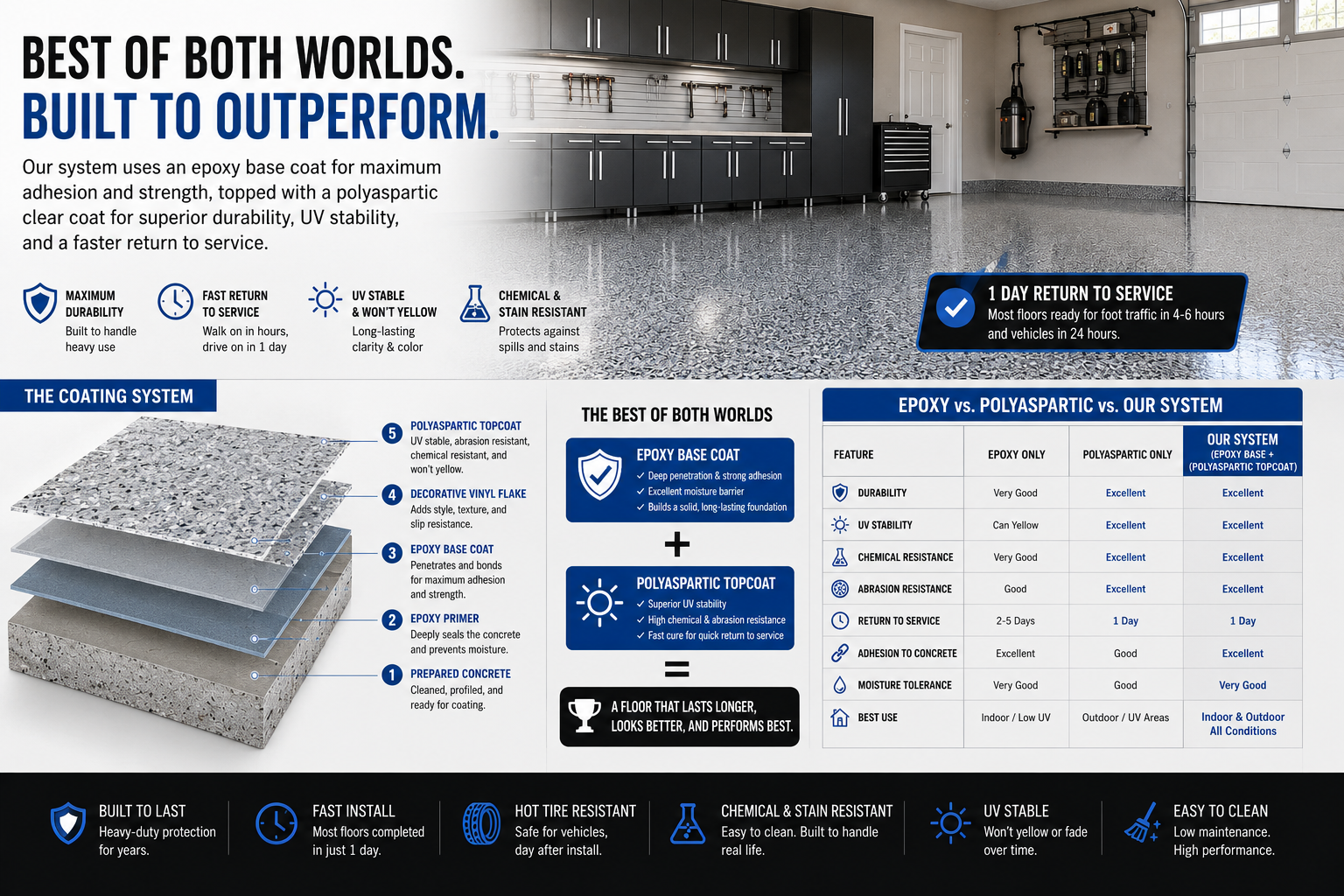
Polyaspartic is usually better as the topcoat. Epoxy is usually better as the base coat. For many residential garage floors, the better question is not “epoxy or polyaspartic?” It is how to use both products in the correct layers.
This combines strong adhesion at the concrete with UV stability, chemical resistance, and a durable wear layer on top.
Polyaspartic vs. Epoxy Garage Floor Comparison
| Feature | Epoxy | Polyaspartic | Concrete Indy System |
|---|---|---|---|
| Best use | Base coat | Topcoat | Epoxy base + polyaspartic topcoat |
| Adhesion | Excellent | Good to excellent | Excellent |
| Cure time | Slower | Faster | Controlled two-day system |
| UV resistance | May amber over time | Better UV stability | UV-stable topcoat |
| Chemical resistance | Good | Very good | Very good |
| Scratch resistance | Good | Very good | Very good |
| Working time | Longer | Shorter | Better base-coat control |
| Best for | Bonding and thickness | Clear protective wear layer | Long-term performance |
What Is Epoxy Garage Floor Coating?
Epoxy is a two-part resin-and-hardener coating with a long record in residential, commercial, and industrial floors. Applied over mechanically prepared concrete, it creates a hard, durable layer and an excellent foundation for full-flake systems.
Advantages of Epoxy
- Strong adhesion to properly prepared concrete
- Long working time for controlled installation
- Good build thickness
- Excellent foundation for full flake broadcast
- Long residential and industrial track record
Disadvantages of Epoxy
- Slower cure time
- Clear epoxy can amber or yellow in UV light
- Often scratches more easily than a quality polyaspartic topcoat
- DIY kits do not equal professional systems
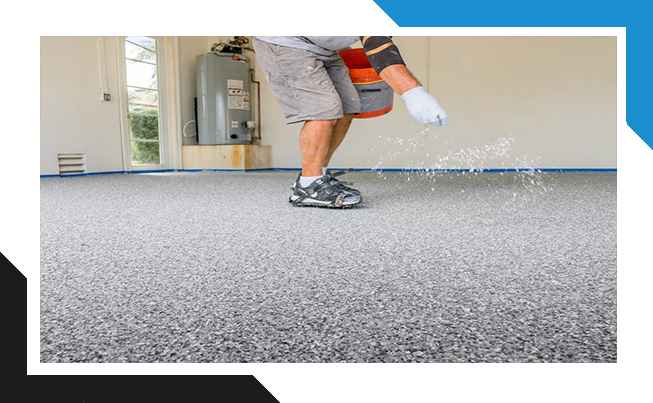
A high-quality coating starts with preparation, a strong base coat, full flake broadcast, and a durable protective topcoat.
What Is Polyaspartic Garage Floor Coating?
Polyaspartic is a high-performance coating known for fast curing, UV stability, chemical and abrasion resistance, and a clear glossy finish. It performs especially well as the topcoat—the layer that handles tires, traffic, tools, oil, salt, water, dirt, equipment, and sunlight.
Advantages of Polyaspartic
- Fast cure time
- Better UV stability than epoxy
- Strong chemical, abrasion, and scratch resistance
- Clear, glossy, high-end appearance
Disadvantages of Polyaspartic
- Short working time
- Less forgiving during installation
- Product quality and crew skill are critical
- One-day systems can prioritize speed over control
Why Concrete Indy Uses Epoxy Base and Polyaspartic Topcoat
We use the right product in the right layer: epoxy for adhesion and foundation strength, full flake for color and texture, and polyaspartic for the protective wear layer.
Strong Adhesion
Epoxy has time to wet into mechanically prepared concrete.
Full-Flake Finish
Complete decorative coverage creates texture and a showroom look.
UV Stability
Polyaspartic helps protect against ambering from open-door sunlight.
Durable Topcoat
Chemical, abrasion, and scratch resistance for everyday garage use.
Why We Do Not Push a One-Day Shortcut
Fast curing is useful, but fastest is not automatically best. Our two-day system gives the crew more control over preparation, adhesion, flakes, and topcoat.
Build the Foundation
- Diamond-grind and prepare concrete
- Repair cracks and imperfections
- Apply professional epoxy base coat
- Broadcast decorative flakes to full rejection
Protect the Floor
- Scrape and remove excess flakes
- Clean and prepare for the clear coat
- Apply polyaspartic topcoat
- Allow the coating to cure correctly
The Most Important Step: Surface Preparation
A floor coating is only as good as the concrete underneath it. Concrete Indy mechanically diamond-grinds the surface to create the correct profile for adhesion.
- Diamond grinding
- Cleaning and removing weak surface material
- Opening the concrete surface
- Repairing cracks, pits, and damage
- Preparing edges and corners
- Vacuuming dust before coating
Skipping preparation is one of the biggest reasons garage coatings peel.
DIY Paint Is Not a Professional Coating
Big-box epoxy kits differ in preparation, product quality, film thickness, flake broadcast, and topcoat performance. Applying coating over smooth, dirty, dusty, sealed, or weak concrete invites failure.
Full Flake Garage Floor Color Options
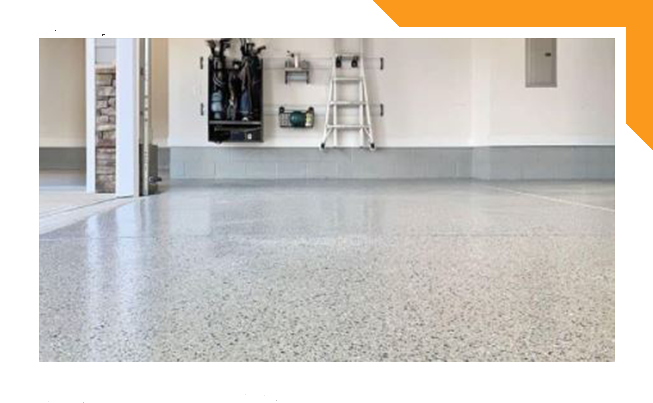
Decorative vinyl flakes create a high-end look, improved texture, better slip resistance, visual camouflage for small imperfections, and a finished showroom appearance.

Gravel

Granite

Creekbed

Stonehenge
Is an All-Epoxy Garage Floor Bad?
No. Epoxy has performed successfully for years. The concern is using clear epoxy as the final topcoat where UV exposure, scratching, chemical resistance, and long-term appearance matter.
Epoxy is excellent for the base. Polyaspartic is excellent for the top.
Is an All-Polyaspartic Garage Floor Bad?
No. A quality system installed by a skilled crew can perform well. But many are marketed mainly around one-day speed. We prefer epoxy at the foundation because base-coat adhesion supports the entire system.
Which Garage Floor Coating Is Best?
For most residential garages, Concrete Indy recommends an epoxy base coat, full decorative flake, and polyaspartic topcoat.
If someone says one product is always better, ask: “Better for which layer?”
Questions to Ask a Garage Floor Coating Contractor
The answers matter more than a one-day sales pitch.
- Do you grind the concrete?
- Do you repair cracks and pits?
- What is the base coat?
- What is the topcoat?
- Is it epoxy, polyaspartic, or hybrid?
- Is it full or partial flake?
- How many days does installation take?
- When can I walk on it?
- When can I drive on it?
- How are moisture issues handled?
- What exactly is included?
Concrete Indy’s Garage Floor Coating System
Concrete Grinding
Mechanically profile the concrete for adhesion.
Crack and Surface Repair
Repair cracks, pits, and imperfections.
Epoxy Base Coat
Apply professional epoxy to prepared concrete.
Full Flake Broadcast
Cover the wet base coat with decorative flakes.
Flake Scrape and Cleanup
Remove excess flakes and prepare the surface.
Polyaspartic Topcoat
Add UV, chemical, and abrasion-resistant protection.
Polyaspartic vs. Epoxy Garage Floor FAQs
Get the Best Garage Floor Coating System
Get epoxy adhesion and foundation strength plus polyaspartic UV stability, chemical resistance, and durability. Our two-day system is built for long-term performance—not a rushed shortcut.