How Often Should Stamped Concrete Be Sealed?
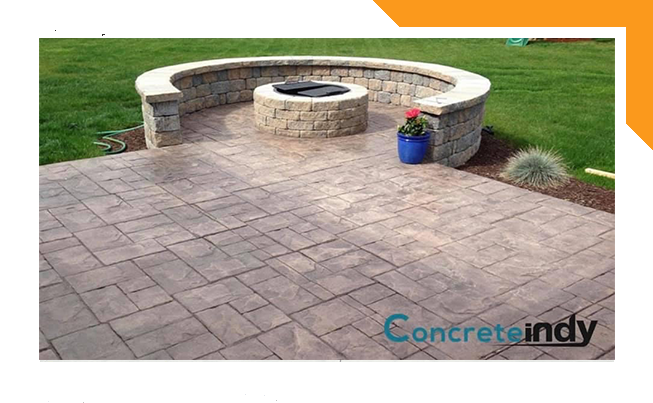
Concrete Indy generally recommends evaluating the original sealer after approximately two years and then resealing stamped concrete about every three years to preserve its rich color, surface protection, and overall appearance.
How Often Should Stamped Concrete Be Resealed?
Most exterior stamped concrete should be inspected every year and resealed approximately every two to three years. For stamped concrete installed by Concrete Indy, our general recommendation is:
- An appropriate cure-and-seal application during original installation
- Evaluate the original sealer at approximately two years
- Maintenance resealing about every three years after that
- Earlier service for heavy traffic, full sun, standing moisture, pool chemicals, or winter exposure
The calendar is only a guideline. Appearance, water resistance, and existing sealer condition should determine when another application is needed.
Concrete Indy’s Stamped-Concrete Sealing Schedule
Annual inspection is smart. Automatic annual sealing usually is not. The correct product should be applied at the correct time.
Original Installation
New stamped concrete receives an appropriate cure-and-seal system that manages moisture loss during curing and begins protecting and enhancing the decorative surface.
First Evaluation: About Two Years
The original application may still perform well or may show maintenance needs depending on sun, traffic, drainage, winter exposure, and care.
Ongoing Maintenance: About Every Three Years
Protected patios may go longer; driveways and heavily exposed surfaces may require attention sooner.
Inspect Every Year
Too many coats can create cloudy areas, uneven gloss, bubbling, peeling, or delamination. Inspect annually, but seal only when required.
Why Does Stamped Concrete Need to Be Sealed?
Stamped concrete is both a structural surface and a decorative finish. Sealer protects its appearance and makes regular maintenance easier.
Richer Color
Color-enhancing sealer deepens the base color and makes antiquing and texture more visible.
Water Beading
It reduces the rate at which water and liquids enter the surface without claiming to make concrete waterproof.
Stain Resistance
It provides more time to remove food, dirt, leaves, oil, grease, and pool contaminants.
Easier Cleaning
Dirt and debris generally wash away more easily from a properly sealed surface.
Finish Protection
Sealer acts as a maintainable sacrificial layer over the decorative finish.
How Can You Tell When Stamped Concrete Needs to Be Resealed?
- The color looks dull or faded when dry
- Water no longer beads and immediately darkens the concrete
- Traffic areas show lighter paths or uneven gloss
- The surface is becoming harder to clean
- The existing coating looks cloudy, white, bubbled, or peeling
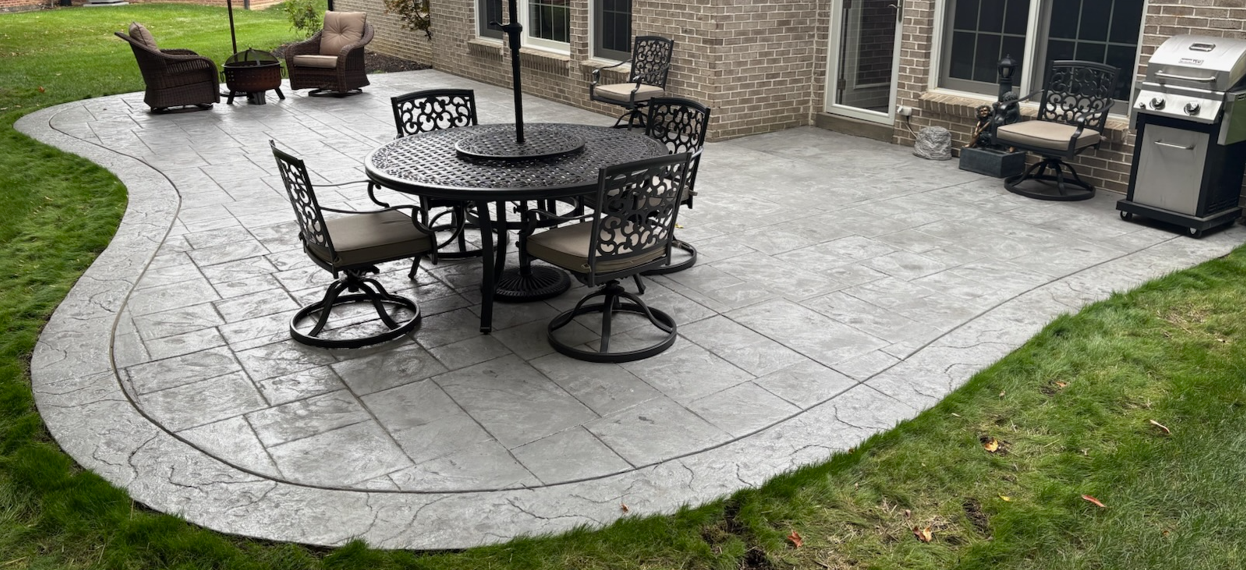
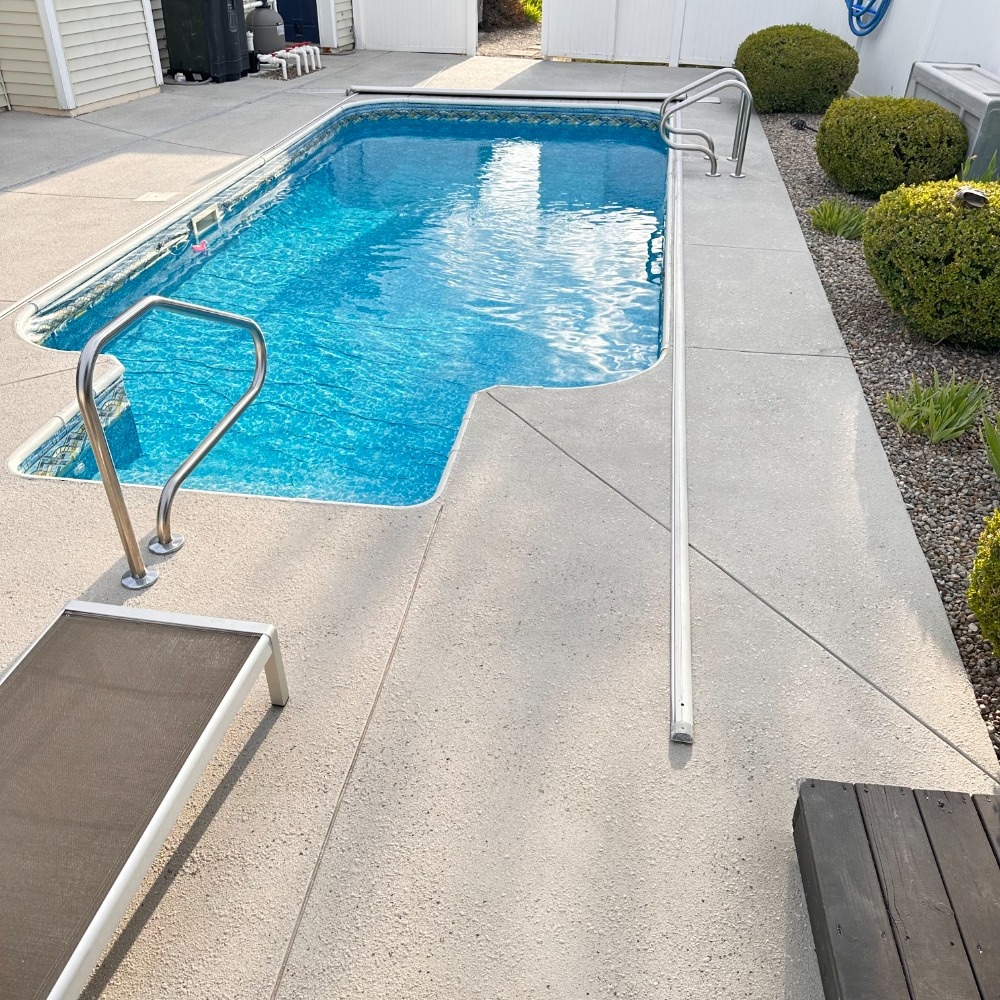
Try This Simple Water Test
- Select a clean, dry section.
- Place a small amount of water on the surface.
- Observe it for five to ten minutes.
- Compare high-traffic and protected areas.
If water remains beaded, the sealer likely retains some repellency. If concrete quickly darkens and absorbs water, the sealer may be worn.
This is only an indicator. Penetrating and film-forming sealers behave differently, and the existing product should be identified before recoating.
What Happens If Stamped Concrete Is Not Resealed?
The concrete does not suddenly fail when a date passes. Neglect affects it gradually.
Color Becomes Dull
The pattern remains, but its rich, wet-look depth, contrast, and sheen diminish.
Greater Absorption
Water, dirt, and spills enter more readily, increasing staining and weather exposure.
Uneven Surface Detail
Antiquing and accent color can wear unevenly across traffic paths and exposed areas.
More Restoration Work
Years of neglect may require deep cleaning, antiquing restoration, or coating removal.
Will Concrete Indy’s Color Disappear Without Sealer?
Concrete Indy uses integral color as the primary base color. It is mixed throughout the concrete rather than relying only on a thin topical color layer.
When sealer wears, the surface can look considerably duller, but the integral base color has not disappeared. Cleaning and a compatible sealer often restore much of the deep appearance.
- Integral base color throughout the mix
- Stamped pattern and texture
- Antiquing for contrast and definition
- Compatible sealer for enhancement and protection
Integral Color vs. Dry-Shake Color Hardener
Integral color is mixed into wet concrete and provides color continuity beneath the wearing surface. Concrete Indy prefers it as the primary base color.
Dry-shake color hardener is broadcast and worked into freshly placed concrete. Correctly installed, it can create a dense, abrasion-resistant colored surface.
Can Stamped Concrete Be Sealed Too Often?
Yes. More is not automatically better. Excess buildup can cause gloss, a plastic appearance, whitening, trapped moisture, bubbles, peeling, delamination, slipperiness, and unevenness.
Does Sealing Make It Slippery?
Film-forming sealers can affect traction, especially on wet pool decks, steps, slopes, driveways, and patios. A compatible traction additive can be used where appropriate, but no outdoor surface is completely slip-proof.
Does Sealer Prevent Cracking?
No. Sealer reduces absorption and maintains appearance; it is not reinforcement. Base, soil, thickness, reinforcement, joints, drainage, loading, roots, and freeze-thaw exposure affect cracking.
Learn why concrete cracksWhat Causes Sealer to Wear Faster?
Vehicle Traffic
Vehicle weight, tire movement, dirt, and road residue increase abrasion.
Direct Sunlight
Continuous ultraviolet exposure affects coatings and decorative appearance.
Winter Exposure
Snow, ice, freezing, road residue, and deicers make maintenance more demanding.
Standing Water
Persistent moisture can cause cloudiness, whitening, and adhesion problems.
Pool Exposure
Water, chemicals, sunscreen, traffic, and cleaning products increase wear.
Aggressive Cleaning
Harsh acids, solvents, excessive pressure, and abrasion can damage sealer.
Incorrect Application
Too much product, damp concrete, unsuitable weather, or incompatibility causes failure.
How Concrete Indy Cleans and Reseals Stamped Concrete
Every project is evaluated individually, but our typical process includes these steps.
Inspect the existing surface
Identify existing sealer compatibility
Thoroughly clean the concrete
Allow the surface to dry completely
Restore antiquing when necessary
Apply the appropriate sealer uniformly
Add traction material where appropriate
Protect the surface during curing
When Should Stamped Concrete Not Be Sealed?
- The surface is wet or rain is expected
- Temperature is outside product requirements
- The coating is peeling or delaminating
- Moisture is trapped beneath old sealer
- An incompatible coating is present
- Oil, dirt, release residue, or contaminants remain
- Repairs or color restoration are required first
How Should Stamped Concrete Be Maintained?
- Sweep dirt, sand, and abrasive debris
- Rinse as needed and clean spills promptly
- Use mild, compatible cleaning products
- Avoid acids, solvents, metal blades, and sharp objects
- Do not drag heavy furniture
- Use caution with deicing chemicals
- Prevent leaves and standing water from remaining
- Inspect the surface each spring
Why Sealing Matters in Central Indiana
Stamped concrete around Indianapolis faces summer heat, direct sunlight, heavy rain, standing moisture, falling leaves, snow, ice, freeze-thaw cycles, road residue, deicing chemicals, and major temperature changes.
Sealer is one part of a complete system. It does not replace air-entrained concrete, a stable base, appropriate thickness, reinforcement, control joints, or proper drainage.
Built and Maintained by Our Team
- In-house W-2 concrete crews
- No subcontracted concrete flatwork
- Integral base color and multiple options
- Professional base preparation and joints
- Commercial-grade sealing products
- Cleaning, antiquing, and resealing services
- Clear maintenance instructions
Does Your Stamped Concrete Need to Be Resealed?
Concrete Indy can inspect, clean, antique, and seal patios, pool decks, walkways, porches, borders, driveways, and other decorative concrete throughout Indianapolis and Central Indiana.
Serving Indianapolis, Carmel, Fishers, Noblesville, Westfield, Zionsville, Brownsburg, Avon, Plainfield, Greenwood, Franklin, Greenfield, and surrounding Central Indiana communities.
Frequently Asked Questions About Sealing Stamped Concrete
Technical References and Further Reading
Sealer types, manufacturer instructions, and project conditions vary. Follow the technical data sheet for the specific product applied.