What Is the Best Base for Concrete?
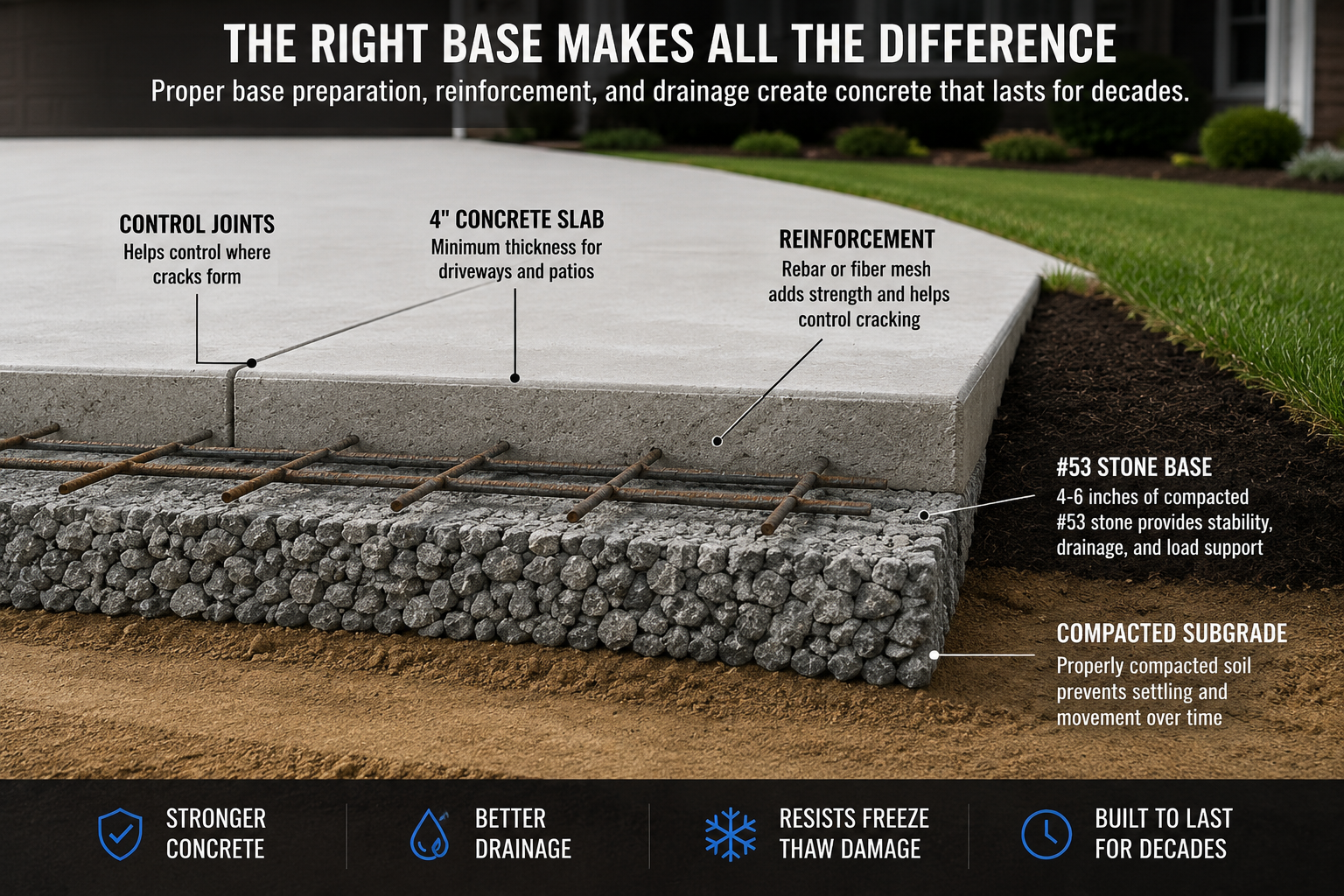
For most residential concrete driveways, patios, sidewalks and exterior slabs in Central Indiana, properly placed and mechanically compacted #53 stone is one of the best base materials available. Its dense-graded combination of larger stone, smaller aggregate and fines compacts into a firm, uniform platform beneath concrete.
A base cannot eliminate every possibility of cracking or movement. Performance also depends on soil, drainage, concrete thickness, reinforcement, joints, mixture, finishing and curing. However, a correctly prepared #53 stone base is an important part of building concrete from the ground up.
What Is #53 Stone?
#53 stone is a dense-graded crushed aggregate used for road bases, construction entrances, driveways, building pads and concrete base preparation. “#53” describes an aggregate gradation, not one exact rock size.
It contains a controlled blend of larger aggregate, smaller particles and stone fines. In Central Indiana, it is commonly supplied as crushed limestone. Under INDOT aggregate gradation, particles range from larger stone through smaller particles and fines, allowing the material to pack more tightly than clean, single-sized stone.
Concrete Indy uses #53 stone because the objective is not to spread loose gravel. The objective is a graded, compacted and uniform supporting layer.
#53 Stone at a Glance
- Material
- Dense-graded aggregate
- Local material
- Crushed limestone
- Primary purpose
- Stability and support
- Contains fines
- Yes
- Free-draining
- No
- Applications
- Exterior flatwork
Why We Prefer #53 Stone Under Concrete
Particle Sizes Lock Together
Smaller particles fill spaces between larger angular aggregate. Intentional fines help the layer bind and compact rather than behave like loose clean gravel.
Uniform Support
Excavation, subgrade correction and compacted stone help reduce soft spots and abrupt changes in support across the slab.
Accurate Grading
Crews can establish thickness, drainage slopes, transitions, and consistent finished elevations before placement.
Better Work Platform
A compacted base creates a cleaner, more dependable platform for forms, reinforcement and placement than disturbed or wet soil.
Multiple Applications
It works beneath driveways, patios, walks, pool decks, sport courts, pads, approaches and other exterior flatwork.
Project-Specific Design
Base depth, concrete thickness and reinforcement still depend on soil conditions, intended loading, drainage and specifications.
Why We Do Not Simply Pour Concrete Over Unprepared Dirt
Native soil is not automatically a suitable finished subgrade. A site can contain topsoil, roots, organic matter, debris, uncompacted fill, clay, wet soil or utility-disturbed areas. These materials react differently when wet, dry, frozen or loaded.
Some slabs can be designed over a properly evaluated soil subgrade. That is different from pouring directly over loose or unprepared dirt.
Preparation may include removing existing paving, vegetation, topsoil or unsuitable material; correcting soft areas; establishing grades; and installing compacted #53 stone where appropriate. Much of the work affecting performance happens before the truck arrives.
#53 Stone vs. #57 Stone Under Concrete
Both aggregates have legitimate construction uses, but they behave differently.
| Feature | #53 Stone | #57 Stone |
|---|---|---|
| Gradation | Dense graded with multiple sizes and fines | Cleaner, open graded with fewer fines |
| Compaction | Locks into a tight, stable layer | Does not bind in the same manner |
| Drainage | Not free-draining | Water moves through more readily |
| Primary strength | Support, grading and stability | Drainage and specific construction details |
| Typical selection | Conventional concrete flatwork base | Drainage-oriented applications |
Why Not Use Pea Gravel, Loose Gravel or Sand?
Pea Gravel
Smooth, rounded particles move against one another and generally do not interlock into the same structural base as angular, dense-graded crushed stone.
Single-Sized Gravel
Clean gravel has useful drainage applications, but retains more open voids and can be harder to fine-grade as a conventional compacted concrete base.
Sand
Sand can work in engineered systems, but performance depends on material type, moisture and compaction. Loose sand is not a universal replacement for compacted aggregate.
Our #53 Stone Base-Preparation Process
Evaluate the Area
We review use, access, elevations, drainage, structures and connections.
Remove Material
Existing paving, vegetation, roots, debris and unsuitable material are removed as needed.
Evaluate Subgrade
Soft, wet or unstable sections may need excavation, drying or replacement.
Place #53 Stone
The required stone is distributed across the prepared area.
Mechanically Compact
Proper equipment reduces voids and locks the aggregate together.
Establish Grade
Crews verify slopes, transitions, elevations and planned slab thickness.
Forms and Reinforcement
Forms and the specified fiber, rebar, wire or other system are installed.
Pour, Joint and Cure
Concrete is placed, finished, textured, jointed, protected and cured.
How Thick Should the #53 Stone Base Be?
No single thickness is correct for every project. Appropriate compacted depth depends on:
- Soil and subgrade stability
- Topsoil or uncontrolled fill
- Vehicle and equipment loads
- Concrete slab thickness
- Drainage and existing elevations
- Excavation depth and specifications
- Local requirements
- Unsuitable material discovered during work
A patio, residential driveway and commercial loading surface should not automatically receive identical designs.
Does a #53 Stone Base Prevent Concrete From Cracking?
No base material guarantees crack-free concrete. Concrete shrinks during curing and exterior slabs respond to temperature, moisture, loading, soil and movement.
A compacted #53 base helps reduce settlement and support-related movement, but durability also depends on thickness, mix, air entrainment where appropriate, reinforcement, joints, drainage, finishing, curing and proper use.
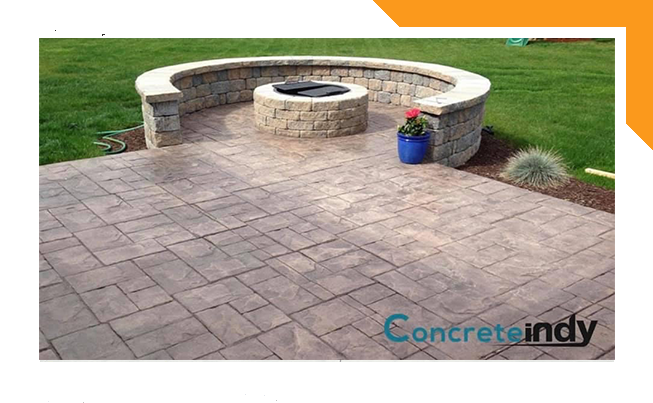
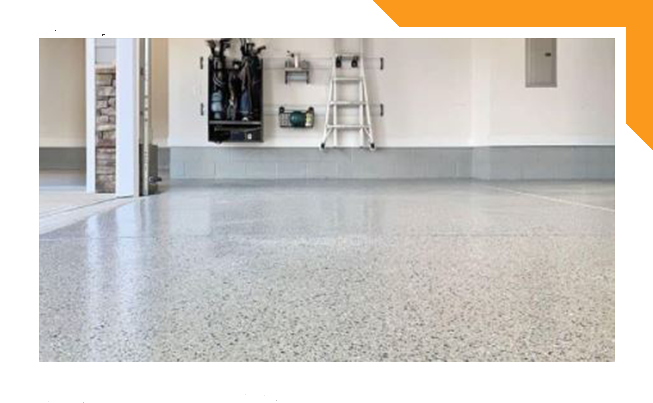
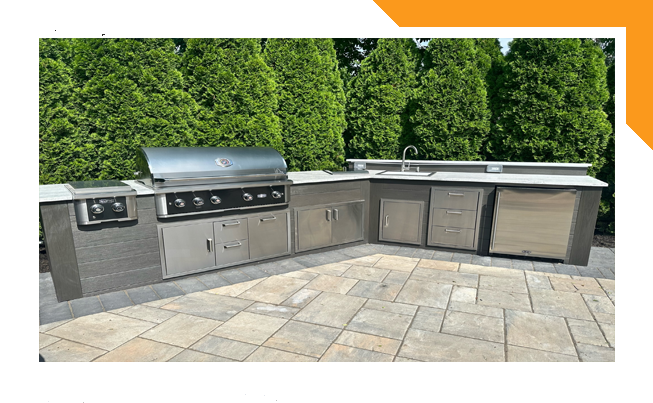
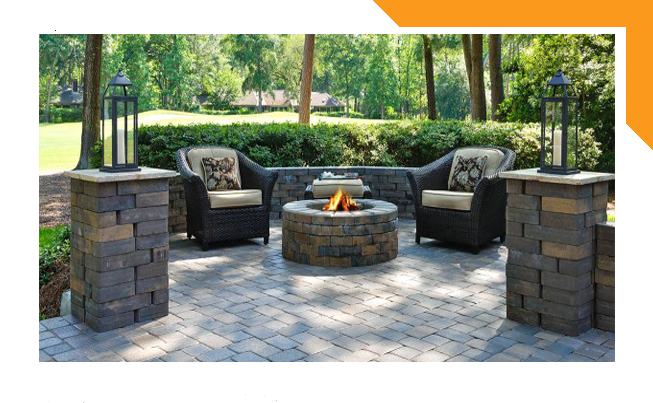
Concrete Projects Built Over Prepared Stone Bases
#53 Stone Base FAQs
Build Your Concrete Project From the Ground Up
Concrete Indy prepares and installs driveways, patios, sidewalks and exterior slabs throughout Indianapolis and Central Indiana. Let us evaluate your site and recommend an appropriate base and concrete system for its intended use.